What to Do When a Publisher Sends You an NDAA Step-by-Step Guide for Indie Devs
Getting a publisher email can feel like momentum. Getting their NDA can feel like pressure. Here's how to handle both without signing something you'll regret.
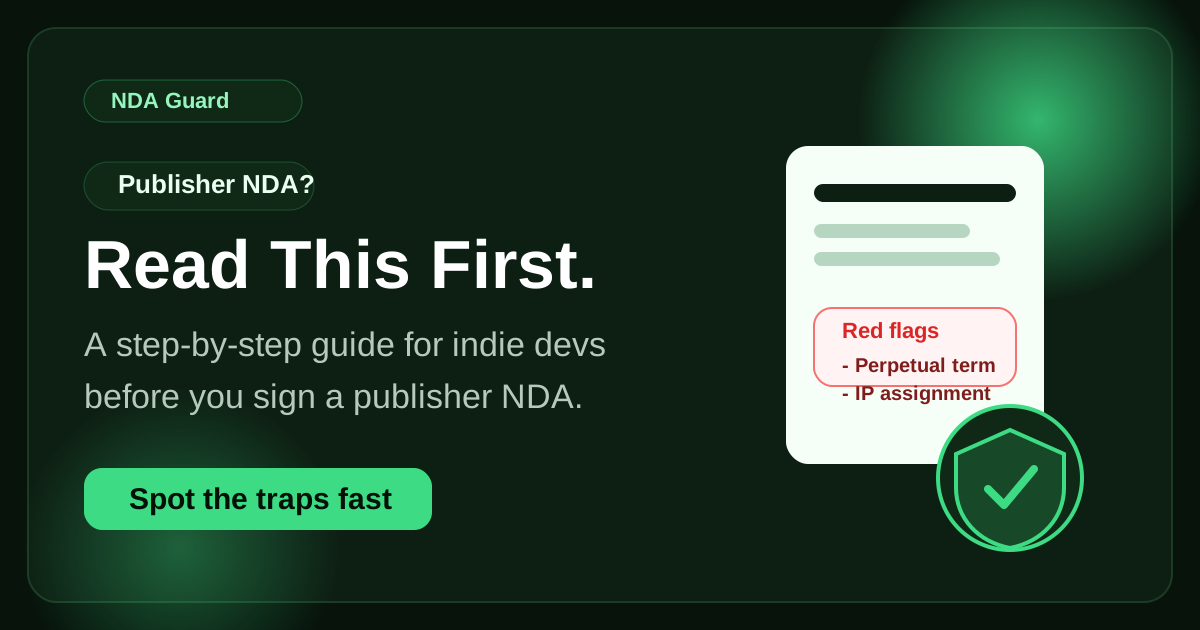
You open your inbox and see the message every solo dev hopes for: a publisher wants to talk. Then the attachment lands. NDA. Sign and send back.
This is the moment where excitement can make you sloppy. You start thinking about visibility, funding, platform support, maybe a real launch plan. The NDA feels like a formality standing between you and the bigger conversation.
Treat that feeling as a reason to slow down, not speed up.
A fair NDA should protect confidential information. It should not quietly grab control over your ideas, your code, or your future options. Here's the fastest practical review process to use before you sign.
Don't sign immediately
The first trap is speed. A publisher says they want to move fast. Someone on their side says the NDA is standard. You get the subtle message that careful review is friction.
That pressure matters. If the other side treats basic review like a problem, that is useful information about how the relationship may go later when the stakes are higher.
Practical response
You do not need to apologize for reading a contract before you sign it. Serious companies expect that. Anyone who doesn't is telling you more than they mean to.
Read the definitions section first
Most indie devs start at the signature line, skim the obligations, and miss the part doing the real damage. Start with definitions. That is where the traps usually hide.
Look for how the NDA defines terms like Confidential Information, Representatives, and Purpose. If those are broad, the rest of the document gets broader with them.
What you want
Clear limits. Marked or clearly identified confidential material, a narrow business purpose, and explicit exclusions for public, pre-existing, and independently developed information.
What should worry you
Definitions that cover anything discussed, anything related to the relationship, or anything the other side later decides was confidential.
If you want a faster checklist for common traps, read 5 NDA Red Flags Every Indie Game Developer Should Know Before Signing. It covers the patterns that show up again and again in publisher NDAs.
Check the term and survival clauses
Two small sections carry a lot of weight: how long the agreement lasts, and how long the confidentiality obligations survive after it ends.
The dangerous version is simple: the deal ends whenever, but your obligations do not. If the NDA says confidentiality survives forever for everything, stop there and read much more carefully.
Fast read
Pay attention to the difference between term and survival. A short agreement term does not help you if the core obligations survive indefinitely.
Look for IP-adjacent language
This is where an NDA stops being "just an NDA." Watch for language about licenses, assignments, feedback, derivative works, ownership, or rights to use materials shared during discussions.
If the document grants the publisher any right to use, retain, exploit, adapt, or own what you send, that is not a confidentiality clause. That is IP language wearing an NDA costume.
Words to scan for
"License," "assign," "derivative works," "feedback," "right to use," "retain," and "work product."
What an NDA should say
Each party keeps its own rights. Information is shared only for evaluation. No ownership transfer and no usage rights beyond the review itself.
This is the point where a quick label check helps: if a clause would make sense in a publishing agreement, consulting agreement, or IP assignment, ask why it is inside the NDA at all.
Use a first-pass tool like NDA Guard
You do not need to manually decode every paragraph before deciding whether an NDA deserves deeper review. A first-pass tool can flag the sections most likely to be a problem so you know where to spend your attention.
That is exactly what NDA Guard is for. Paste the text, get a clause-by-clause risk scan, and see where the document starts drifting beyond normal confidentiality terms.
Use it for the first pass, not the final call
Know when to get a real lawyer involved
Some documents are not DIY territory. Bring in a lawyer when the NDA starts affecting ownership, future products, exclusivity, unusual liability, or cross-border enforcement.
Escalate if you see:
- IP assignment or license language.
- Perpetual or unusually long survival clauses.
- Non-compete, exclusivity, or work-product wording.
- One-sided remedies, venue provisions, or anything you do not understand after a careful read.
Spending a little on legal review before you sign is usually cheaper than fixing a bad contract after the fact. Especially when your game or your engine is the asset being discussed.
Slow down before you sign
When a publisher sends an NDA, the right move is not panic and it is not blind trust. It is a clean first pass: pause, read the definitions, check the term, scan for IP language, and escalate when the document stops looking like a normal confidentiality agreement.
If you want a fast review before you reply, run the NDA through NDA Guard. If you want another practical checklist first, read our guide to the five biggest NDA red flags.
Try NDA Guard free before you reply
Paste the NDA you received and get an instant first-pass risk analysis before you sign, negotiate, or forward it to counsel.