5 NDA Red Flags Every Indie Game Developer Should Know Before Signing
Publishers, partners, and contractors slide NDAs across the table every day. Most indie devs sign without reading. Here are the five clauses that can quietly destroy your studio.
You just got an email from a publisher interested in your game. Or maybe a contractor wants to help with art assets. Or a platform is offering an exclusivity window. Before any real conversation happens, they send over an NDA.
Seems routine, right? It's "just an NDA." It's not the actual deal. So you sign it and move on.
That's exactly how indie devs lose their IP.
NDAs are legal agreements. They carry weight. And the ones that land in your inbox aren't written to protect you— they're written to protect the other party. Some of them go much further than confidentiality, quietly locking down your rights to your own work.
We reviewed hundreds of NDAs sent to indie game developers. These are the five most dangerous patterns we found — and what fair language actually looks like.
Confidentiality Obligations That Never Expire
The single most common red flag. You sign an NDA before a pitch meeting, and the confidentiality clause has no end date. You're bound to silence — potentially forever — about information that might become public anyway.
This matters because game development moves fast. Concepts you discussed under NDA with Publisher A might overlap with ideas you develop independently six months later. If the NDA never expires, they could argue your "new" concept was derived from their confidential information.
What dangerous language looks like:
"The Receiving Party agrees to hold all Confidential Information in strict confidence and shall not disclose such information to any third party without the prior written consent of the Disclosing Party. This obligation shall survive in perpetuity."
What fair language looks like:
"The confidentiality obligations under this Agreement shall remain in effect for a period of two (2) years from the date of disclosure, except with respect to trade secrets, which shall be protected for so long as they remain trade secrets under applicable law."
The standard:Most fair NDAs in the gaming industry use a 2-3 year term for general confidential information, with a separate carve-out for actual trade secrets. If someone insists on "perpetual" confidentiality for everything — including meeting notes and pitch decks — that's not standard. That's a trap.
Definitions Broad Enough to Cover Your Pre-Existing Work
The definition of "Confidential Information" is the most important paragraph in any NDA. If it's too broad, it can reach backward in time and claim ownership over work you created before the NDA even existed.
Here's a real scenario: you share a game demo with a potential publisher under NDA. Their definition of "Confidential Information" includes "all materials, code, concepts, designs, and know-how shared during the course of discussions." Suddenly, the engine you built over three years could be construed as "shared" confidential information — meaning you now owe them silence about your own technology.
What dangerous language looks like:
"Confidential Information shall mean all information, whether written, oral, electronic, or visual, disclosed by either party in connection with this Agreement, including but not limited to source code, game designs, business strategies, know-how, and any materials developed or provided during the relationship."
What fair language looks like:
"Confidential Information shall mean information that is (a) clearly marked as 'Confidential' at the time of disclosure, or (b) if disclosed orally, identified as confidential at the time of disclosure and confirmed in writing within 30 days. Confidential Information does not include information that the Receiving Party can demonstrate was already in its possession prior to disclosure."
What to look for:A fair NDA explicitly excludes pre-existing work, publicly available information, and independently developed material. If there's no exclusion clause, your existing game engine, art pipeline, or design documents could all fall under their definition.
Language That Quietly Shifts Ownership or Reuse Rights
This is the hidden IP trap. Some NDAs include language that goes beyond confidentiality and starts touching intellectual property rights. They might not say "we own your IP" outright — instead, they use phrases like "license to use," "right to retain," or "derivative works" buried in the confidentiality section.
The effect? By signing what looks like a standard NDA, you've actually given the other party a license to use concepts, designs, or code you shared during discussions — even if the deal falls through.
What dangerous language looks like:
"The Disclosing Party grants to the Receiving Party a non-exclusive, royalty-free, perpetual license to use, modify, reproduce, and create derivative works from any Confidential Information shared under this Agreement for the Receiving Party's internal business purposes."
What fair language looks like:
"Nothing in this Agreement grants either party any right, title, or interest in the other party's Confidential Information, except the limited right to review such information for the purpose of evaluating the potential business relationship described herein. All Confidential Information remains the sole property of the Disclosing Party."
Why this is sneaky:An NDA should be a confidentiality agreement, period. The moment it starts granting licenses or defining derivative works, it has crossed into IP agreement territory. If you see words like "license," "derivative," "retain," or "reuse" in an NDA — stop and read very carefully.
One-Sided Legal Remedies With No Carve-Outs
Many NDAs include a section on "remedies" — what happens if someone breaches the agreement. The concerning pattern here is language that gives only one party the right to seek injunctive relief (a court order to stop you from doing something), while offering you no equivalent protection.
Even more concerning: these clauses often state that the non-breaching party can seek injunctive relief "without the necessity of proving actual damages." Translation: they can haul you into court without having to show they were actually harmed.
What dangerous language looks like:
"The Receiving Party acknowledges that any breach of this Agreement will cause irreparable harm to the Disclosing Party, and the Disclosing Party shall be entitled to seek injunctive relief and specific performance without the necessity of proving actual damages or posting any bond."
What fair language looks like:
"Both parties acknowledge that a breach of the confidentiality obligations may cause irreparable harm. Either party may seek equitable relief, including injunctive relief, in addition to any other remedies available at law. Nothing in this section shall limit either party's right to seek damages."
The key difference: Fair remedies are mutual. Both parties get the same protections. If the NDA only protects one party's right to seek legal action, you're signing an agreement that assumes you're the threat and they're the victim — before anything has even happened.
Assignment Clauses Hiding Inside "Standard" NDA Wording
This is the most dangerous red flag because it turns an NDA into something else entirely: an IP assignment agreement. These clauses typically appear near the end of the document and state that any work, ideas, or materials "arising from" or "related to" discussions under the NDA are automatically assigned to the other party.
Imagine this: you pitch a game concept to a publisher under NDA. The deal doesn't work out. Six months later, you release a game using the same concept. If the NDA had an assignment clause, the publisher could argue they own that concept — because it "arose" from your discussions.
What dangerous language looks like:
"Any inventions, concepts, designs, or works of authorship conceived, created, or developed by the Receiving Party in connection with or arising from the exchange of Confidential Information shall be the sole and exclusive property of the Disclosing Party, and the Receiving Party hereby assigns all right, title, and interest in such works to the Disclosing Party."
What fair language looks like:
"This Agreement does not transfer or assign any intellectual property rights. Each party retains all rights to its pre-existing intellectual property and to any inventions, concepts, or works created independently outside the scope of this Agreement."
The bottom line: An NDA should never contain assignment language. If you see "assigns," "transfers," or "hereby grants all right, title, and interest" in a document labeled as an NDA, you're not looking at an NDA anymore. You're looking at an IP agreement dressed in NDA clothing — and you should treat it accordingly.
Don't Sign Blind
NDAs are a normal part of doing business in the game industry. But "normal" doesn't mean "safe." Every one of these red flags came from real NDAs sent to real indie developers. In many cases, the developers signed without reading — because the document was long, the language was dense, and the deal felt too important to slow down for legal review.
You don't need a law degree to protect yourself. You just need to know what to look for:
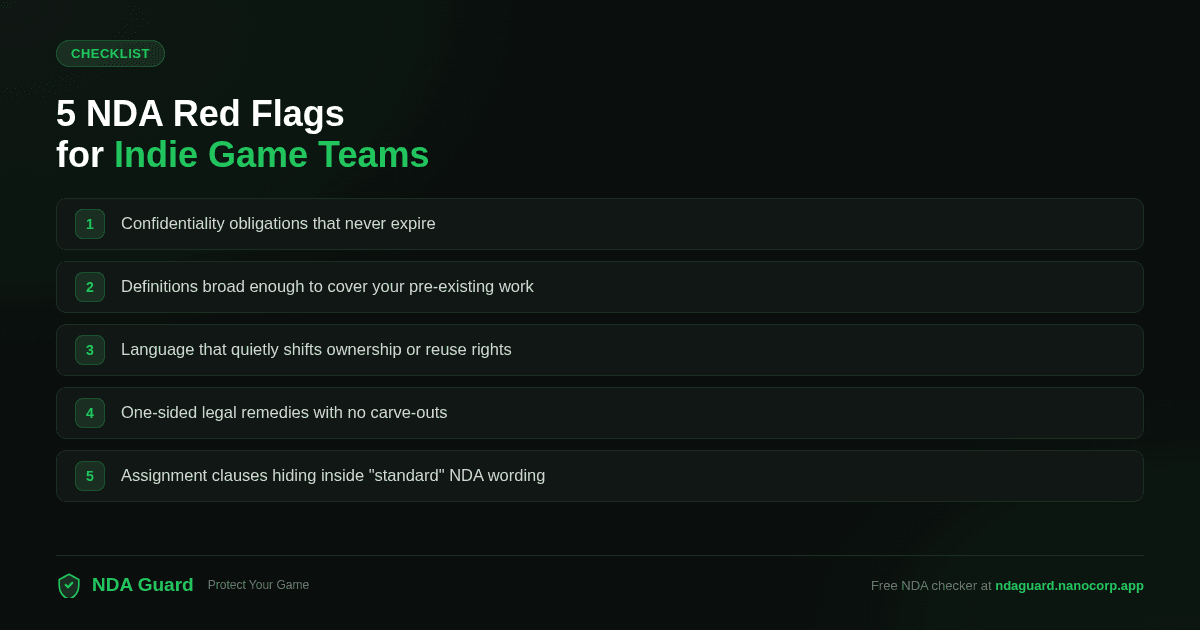
- 1.Perpetual obligations — confidentiality should have an end date
- 2.Overbroad definitions — your pre-existing work must be excluded
- 3.Hidden IP licenses — NDAs shouldn't grant usage rights
- 4.One-sided remedies — protections should be mutual
- 5.Assignment clauses — an NDA should never transfer IP ownership
If you just got a publisher NDA and want a calmer step-by-step review flow, start with What to Do When a Publisher Sends You an NDA.
Or, let NDA Guard do the reading for you.
Analyze your NDA in seconds
Paste any NDA into NDA Guard and get an instant AI-powered risk analysis — flag predatory clauses, understand what you're really signing, and get counter-proposal language. Free, no signup required.
Try NDA Guard Free